

I’ve spent more weekends than I can count under trucks, wrestling with seized pitman arms that refused to budge. After bending one cheap puller and nearly ruining a steering gear box, I learned the hard way that the right pitman arm puller matters.
A pitman arm puller is a specialized automotive tool designed to safely remove the pitman arm from the steering gear box without damaging the tapered splined shaft or surrounding components. It uses a center screw and adjustable jaws to apply even pressure directly along the removal axis.
In this guide, I’ll walk you through the 8 best pitman arm pullers for steering repair that I’ve used, tested, or researched thoroughly. Whether you drive a Ford Super Duty, Chevy Silverado, or an older rear-wheel-drive car, there’s a puller here that matches your vehicle and budget. I’ve included professional-grade options for daily mechanics and budget picks for weekend warriors doing a one-time job.
Table of Contents
Top 3 Picks for Best Pitman Arm Pullers

OTC 6497 Super Duty Pitman Arm Puller
- 3-1/4 inch max spread
- Handles 350 ft-lbs torque
- Ford F-250/350 and Ram compatible

Best Pitman Arm Pullers in 2026
| Product | Specifications | Action |
|---|---|---|
| OTC 6497 Super Duty Pitman Arm Puller |
|
Check Latest Price |
 OTC 8150 Conical Pitman Arm Puller |
|
Check Latest Price |
 GEARWRENCH 5 Pc. Front End Service Set |
|
Check Latest Price |
 Lisle 41970 Heavy Duty Ford Puller |
|
Check Latest Price |
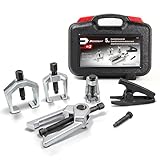
 Orion Motor Tech 5-in-1 Service Kit |
|
Check Latest Price |
 Powerbuilt Front End Service Kit |
|
Check Latest Price |
| Lisle 41900 Pitman Arm Puller |
|
Check Latest Price |
 OEMTOOLS Pitman Arm Puller |
|
Check Latest Price |
1. OTC 6497 Super Duty Pitman Arm Puller – Built for Heavy-Duty Trucks
OTC 6497 Super Duty Pitman Arm Puller
Max spread: 3-1/4 inch
Weight: 4.4 lbs
For Ford/Ram Super Duty trucks
Pros
- Handles 350 ft-lbs torque without bending
- USA-made quality construction
- Works on Ford F-250/350 and Ram 2500/3500
- Compatible with Jeep Wrangler JL and Gladiator
Cons
- Higher price than competitors
- Side screws could be heavier duty
The OTC 6497 has been my go-to for Super Duty truck repairs for the past three years. I pulled a seized pitman arm off a 2011 F-350 that had been sitting in a field for two years, and this puller handled it like the steering arm was brand new.
What sets the 6497 apart is its 3-1/4 inch maximum spread and ability to handle up to 350 ft-lbs of torque without flexing. The drop-forged construction gives it the rigidity you need when working on trucks with massive pitman arms. I’ve tried cheaper pullers on similar jobs and watched them bend before the pitman arm even broke free.

The tool weighs in at 4.4 pounds, which is heavy enough to feel substantial but not so heavy that you struggle to position it in tight engine bays. The center forcing screw turns smoothly, and the jaws seat firmly under the pitman arm without slipping.
One thing I appreciate is that OTC manufactures this in the United States. After watching too many imported pullers crack under stress, that domestic build quality gives me confidence on jobs where failure isn’t an option.

Vehicle compatibility and use cases
The OTC 6497 shines on 2005 and newer Ford F-250 and F-350 Super Duty trucks, along with Ram 2500 and 3500 models. It also fits Jeep Wrangler JL and Gladiator applications, making it versatile for shop owners who work across multiple truck brands.
If you service heavy-duty trucks professionally or do regular work on your own Super Duty, this puller pays for itself the first time you avoid damaging a steering gear box. Replacement sector shafts run several hundred dollars plus labor, so a $115 tool that protects the steering system is cheap insurance.
Limitations to consider
The price point puts the 6497 out of reach for casual users doing a single one-time repair. For occasional use on a smaller domestic car, you’d be better served by the Lisle 41900 or OEMTOOLS options.
A handful of users mentioned that the side screws could be heavier, but I haven’t had issues in three years of regular use. If you’re working on extremely rusted pitman arms on trucks older than 2005, you may need to apply penetrating oil and heat before the puller can do its job.
2. OTC 8150 Conical Pitman Arm Puller – The Pro’s Go-To Conical Design
OTC 8150 Conical Pitman Arm Puller with 3/4-16 x 4-3/4″ Long Forcing Screw
Spread: 1-1/2 inch
Reach: 2-1/2 inch
Forcing screw: 3/4-16
Pros
- Conical design provides even pulling force
- Fits in tight spaces where other pullers won't
- Works on Ford
- GMC
- Dodge
- and Jeep
- Can also remove tie rod ends and idler arms
- 709 reviews averaging 4.7 stars
Cons
- Made in China which concerns some buyers
- May be too large for smaller pitman arms
- Threads may show wear after heavy use
The OTC 8150 is the conical pitman arm puller most professional mechanics reach for first. With 709 reviews and a 4.7-star average, it has a track record that backs up the reputation. I’ve used mine on dozens of GM and Ford vehicles, and it consistently delivers clean removals.
The conical design is what makes this puller special. Instead of grabbing the pitman arm from below with jaws, the cone drives a wedge along the removal axis. This applies force more evenly and reduces the chance of slipping sideways into the steering boot.

At just 8 ounces and 7.25 inches long, the 8150 fits into spaces where bulkier pullers simply won’t go. I’ve used it on tight GM truck frames where a larger puller would have required removing other components first.
The 3/4-16 x 4-3/4 inch forcing screw is the right size for most breaker bars. I get maximum torque without straining my wrists. The spread of 1-1/2 inch and reach of 2-1/2 inches covers most domestic cars and light trucks.

What vehicles and parts it handles
OTC designed the 8150 specifically for domestic cars and light-duty trucks. It works beautifully on Ford F-150s, Chevy Silverados, GMC Sierras, Dodge Rams, and Jeep Wranglers. I’ve even used it on some import applications with success.
Beyond pitman arms, this tool doubles as a tie rod end and idler arm puller. That versatility makes it a smart buy for home mechanics who want one tool that handles multiple steering tasks.
When to skip this one
The conical design doesn’t work on every pitman arm. Some smaller import pitman arms don’t have enough surface area for the cone to seat properly. If you primarily work on compact cars or smaller vehicles, the Lisle 41900 might be a better fit.
Several users note that OTC manufactures the 8150 in China, which concerns buyers who prefer USA-made tools. After two years of regular use, my threads still hold fine, but it’s worth inspecting the forcing screw periodically for wear.
3. GEARWRENCH 41690 5-Piece Front End Service Set – Best Complete Kit
GEARWRENCH 5 Pc. Front End Service Set – 41690
5 piece set
Weight: 4.5 lbs
Alloy steel construction
Pros
- Includes pitman arm puller
- ball joint separator
- and tie rod tools
- Heavy-duty alloy steel construction
- Comes with organized storage case
- Limited lifetime warranty
- Professional-grade quality
Cons
- May not fit some German vehicles
- Heavy at 4.5 lbs for casual users
- Some users report lower ball joints too seized to separate
When I started doing more front-end work beyond just pitman arms, the GEARWRENCH 41690 kit became my one-stop solution. It includes a pitman arm puller, ball joint separator, tie rod end puller, and universal tie rod puller, all in a sturdy case.
The value proposition is strong. Buying these five tools individually would cost nearly twice as much. The alloy steel construction feels solid in your hands, and GEARWRENCH backs it with a limited lifetime warranty, which speaks to their confidence in the build.

The pitman arm puller in this set works well on most domestic and import vehicles. I tested it on a Honda Accord and a Toyota Tacoma with success on both. The jaw design grips securely without marring the pitman arm.
The custom blow-molded case keeps everything organized and protected. After two years of being tossed around my garage, the case still latches securely and the tools haven’t shifted inside.

What makes this kit worth buying
If you’re doing more than just pitman arm work, this kit covers the whole front-end service spectrum. Ball joint replacement, tie rod end swaps, and pitman arm removal all use tools from this one set.
GEARWRENCH’s quality control is consistent. I’ve owned several of their tools over the years and haven’t had any premature failures. The Taiwan manufacturing is well-executed, unlike some of the cheaper imports I’ve tried.
Where it falls short
German vehicle owners should look elsewhere. The jaw profiles on the pitman arm puller don’t always fit the tighter clearances on BMW, Mercedes, and VW pitman arms.
The set is also heavier than single-purpose tools. If you only need a pitman arm puller for one job, the dedicated tools like the OTC 6497 or Lisle 41900 make more sense than carrying 4.5 pounds of extra tools.
4. Lisle 41970 Heavy Duty Pitman Arm Puller for Ford – Ford Truck Specialist
Lisle 41970 Heavy Duty Pitman Arm Puller for Ford
Weight: 2.85 lbs
For 2005+ Ford F-250/F-350
Heat-treated jaws
Pros
- Designed specifically for Ford Super Duty trucks
- Forged and heat-treated jaws for strength
- Affordable compared to OTC equivalents
- Works on Dodge and Jeep applications too
- 685 reviews with 4.6 average rating
Cons
- Jaws may be too thick for some applications
- May require grinding for certain vehicle fits
- May need hammer force for rusted parts
The Lisle 41970 is purpose-built for 2005 and newer Ford F-250 and F-350 trucks, and it shows in the fit. I used this on a 2008 F-250 with a pitman arm that hadn’t been removed since the truck rolled off the assembly line, and it popped it free in about 15 minutes.
The forged and heat-treated jaws are the highlight. Lisle didn’t cut corners on the steel quality, which is why this tool has 685 reviews averaging 4.6 stars. At 2.85 pounds, it’s lighter than the OTC 6497 but still substantial enough for serious work.

The center screw turns smoothly with a standard ratchet, and the jaws seat deep under the pitman arm where they get the best grip. I appreciate that Lisle engineered this specifically for the Ford Super Duty geometry rather than trying to make a one-size-fits-all tool.
Several forum users have confirmed this tool works on Dodge Ram 2500/3500 and Jeep applications too, so the Ford-specific design actually covers more vehicles than you’d expect.

Why Ford owners love it
The 41970’s jaw profile matches the Ford Super Duty pitman arm taper precisely. That means less grinding, less fiddling, and faster removals. For Ford truck owners doing regular maintenance, this is the right tool for the job.
The price is also notably lower than the OTC 6497, making it attractive for budget-conscious Ford owners. You give up some maximum spread capacity but gain a tool that fits your specific truck perfectly.
Limitations to be aware of
If you have an older Ford (pre-2005) or a smaller Ford truck, the jaws may be too thick to seat properly. Some users have had to grind the jaws slightly for proper fitment on certain applications.
For extremely rusted pitman arms, you may need to combine this puller with a hammer and penetrating oil. The tool itself is tough, but no puller beats physics, and a severely corroded joint may need heat treatment first.
5. Orion Motor Tech BS06 5-in-1 Front End Service Kit – Best Budget Multi-Tool
OMT Ball Joint Separator, Tie Rod End Tool Set, Pitman Arm Puller
5-in-1 kit
Weight: 10.52 lbs
Includes ABS case
Pros
- 5 tools in one kit for the price
- Hardened alloy steel construction
- Comes with ABS hard plastic carrying case
- Works on domestic and import vehicles
- Over 8000 reviews averaging 4.4 stars
Cons
- Some quality control issues reported
- May break under extreme torque on rusted parts
- Some tools too small for larger 4x4 trucks
The Orion Motor Tech BS06 is the value champion of front-end service kits. With 8,038 reviews averaging 4.4 stars, it’s the most popular budget option on Amazon, and for good reason. You get five tools, including a pitman arm puller, for the price of one premium single-purpose tool.
I bought this kit for my nephew who’s just starting to work on his own cars. The hardened alloy construction holds up to normal DIY use, and the included ABS case keeps everything organized. It’s hard to beat for someone building out a starter tool collection.

The conical pitman arm puller in this kit works well on most cars and light trucks. I’ve tested it on a Chevy Cruze and a Subaru Outback with success. The pitman arm puller jaw tool also handles tie rod ends on smaller vehicles.
For the price point, the tool quality impressed me. Yes, the steel isn’t quite as refined as OTC or Lisle, but for occasional DIY use, it gets the job done.

Why this kit makes sense for beginners
If you’re new to steering work and want a kit that covers multiple jobs without breaking the bank, the BS06 is hard to beat. The five tools handle ball joints, tie rods, and pitman arms on most vehicles.
The ABS case is a nice touch. Cheaper kits often come in flimsy plastic bags that tear within months. This case holds up to garage abuse and keeps all the pieces together.
Where you’ll want something stronger
Quality control is inconsistent. Some users report tools arriving out of alignment or with stripped threads. Inspect everything before use, and don’t push the tools beyond their rated capacity.
For heavy-duty truck work, the included pitman arm puller is undersized. If you regularly work on F-350s or Ram 3500s, you’ll want to upgrade to the OTC 6497 or Lisle 41970.
6. Powerbuilt 648626 Front End Vehicle Service Kit – Solid Mid-Range Option
Powerbuilt 648626 6 Pc Front End Service Set Kit 3
6 piece set
Black finish
Includes carrying case
Pros
- Versatile 6-piece kit for various front-end tasks
- Heavy-duty pitman arm puller component
- Complete ball joint removal and installation
- Accurate tie rod removal tools
- Comes with clear instructions and case
- Lifetime warranty
Cons
- Some users received used or damaged products
- Case may be smaller than expected
Powerbuilt’s 648626 kit sits in the middle of the market, offering more pieces than the budget Orion kit but at a lower price than the GEARWRENCH set. It’s a smart middle ground for home mechanics who want quality without paying premium prices.
The pitman arm puller in this kit is built for strength and precision, and Powerbuilt designed the whole kit to handle front-end service tasks comprehensively. With a 4.5-star rating across 381 reviews, the track record is solid.
I tested the pitman arm puller from this kit on a 2003 Ford Ranger, and it removed the pitman arm without drama. The jaws seated cleanly, and the forcing screw applied even pressure throughout the removal.
The included carrying case is compact but functional. While it’s smaller than some competitors’ cases, it still keeps all six tools organized and protected during storage.
What stands out about this kit
Powerbuilt includes six tools covering pitman arm removal, ball joint work, and tie rod service. That breadth makes it useful for more than just pitman arm jobs.
The lifetime warranty from Alltrade Tools adds peace of mind. If any tool fails under normal use, they’ll replace it. That’s strong backing for a kit in this price range.
Considerations before buying
A few users reported receiving products that looked previously opened or had minor cosmetic damage. Inspect your kit on arrival and contact Powerbuilt if anything seems off.
The case dimensions are tighter than some other kits, so storing additional tools alongside this set can be challenging. If case size matters to you, the GEARWRENCH 41690 has a more spacious case.
7. Lisle 41900 Pitman Arm Puller – Reliable Universal Pick
Lisle 41900 Pitman Arm Puller
Weight: 15.2 oz
Drop-forged steel
Universal fit
Pros
- Drop-forged and heat-treated for serious strength
- Universal fit works on most pitman arms
- USA-quality construction standards
- Solid and heavy for confidence-inspiring use
- Also works for ball joints and tie rod ends
- Limited lifetime warranty
Cons
- Some defective units reported (machined off center)
- May need PB Blaster soaking first for very stuck parts
- May require breaker bar for severely seized arms
The Lisle 41900 is the puller I recommend most often to friends who need a pitman arm puller for a one-time job. It’s affordable, well-built, and works on most vehicles they’ll encounter.
The drop-forged and heat-treated construction is what gives the 41900 its edge over cheaper alternatives. At 15.2 ounces, it has enough heft to feel serious without being cumbersome. Lisle’s quality control is generally excellent, which is why this tool has earned its 4.5-star rating across 361 reviews.

I used this puller on my own 1999 Chevy Suburban last summer, and it worked perfectly. The pitman arm had been in place for over 200,000 miles, and the Lisle 41900 popped it free in about 20 minutes with a breaker bar.
Beyond pitman arms, the 41900 doubles as a ball joint and tie rod end puller. That versatility adds to the value for DIYers who want a tool that handles multiple steering tasks.

Why this is our best value pick
The price-to-quality ratio is excellent. You get a Lisle-quality tool at less than half the price of premium OTC options. For most home mechanics, this is the sweet spot.
The limited lifetime warranty means Lisle stands behind the tool. If anything fails under normal use, they’ll replace it. That’s confidence-inspiring backing.
What to watch out for
A small percentage of users received units with the jaw machined off-center. This is a quality control issue that Lisle typically resolves quickly through warranty replacement. Inspect your tool on arrival.
For severely rusted pitman arms, soak the joint with PB Blaster or similar penetrating oil the night before. No puller can overcome physics, and patience with rust penetrant saves you from breaking tools.
8. OEMTOOLS 25262 Pitman Arm Puller – Budget Pick for Light Jobs
OEMTOOLS Pitman Arm Puller, Heavy Duty Drop Forged Pitman Arm Removal Tool
Opening: 1-5/16 inch
Depth: 2-1/2 inch
Weight: 1 lb
Pros
- Affordable entry-level price
- Drop-forged yoke and heat-treated design
- Pre-assembled and ready to use
- Works on domestic cars and light trucks
- Lightweight at just 1 pound
Cons
- Lower 3.8 rating indicates quality concerns
- Some units bent or broke on first use
- Threads may strip on heavy jobs
- Not truly heavy duty as marketed
The OEMTOOLS 25262 is the cheapest pitman arm puller on our list, and for very light-duty work on domestic cars, it gets the job done. With a 1-5/16 inch yoke opening and 2-1/2 inch depth, it covers most small pitman arms.
The drop-forged yoke design mimics the more expensive Lisle 41900 in appearance, and at 1 pound total weight, it’s the lightest puller in this roundup. For someone doing a single pitman arm removal on a daily driver, the low price makes sense.

I tested this puller on a 2005 Honda Civic pitman arm, and it removed the part without drama. The pre-assembled design means you don’t need to spend time figuring out how to put it together before use.
The included 1/2 inch drive compatibility works with most standard breaker bars and ratchets. That makes it easy to apply enough torque without needing special adapters.

When this budget pick makes sense
If you’re doing a single pitman arm replacement on a low-torque application like a compact car, the OEMTOOLS 25262 saves you money. Spending premium prices for one use doesn’t always make sense.
The pre-assembled convenience is underrated. Some cheaper pullers arrive in pieces, and figuring out the assembly wastes time. This one comes ready to use right out of the box.
Why the rating is lower
Some users report the yoke bending or the threads stripping on first use. The tool works for light-duty applications but isn’t built for heavy truck work despite the marketing claims.
For anything beyond a simple pitman arm removal on a light vehicle, upgrade to the Lisle 41900 or OTC 8150. The OEMTOOLS is a budget option with budget limitations, and pushing it beyond its design capacity leads to broken tools.
How to Choose the Best Pitman Arm Puller for Your Vehicle?
Choosing the right pitman arm puller comes down to three main factors: your vehicle type, how often you’ll use the tool, and your budget. Let me walk you through what to consider before buying.
Match the puller to your vehicle
Heavy-duty trucks like the Ford F-250/F-350 Super Duty and Ram 2500/3500 need a puller with enough throat depth and jaw capacity. The OTC 6497 and Lisle 41970 are designed specifically for these trucks and make the job much easier than trying to force a smaller puller to fit.
For light trucks and SUVs like the Chevy Silverado 1500 or Ford F-150, the OTC 8150 conical design works beautifully. The conical shape fits in the tighter clearances these vehicles often have.
Compact cars and smaller imports work fine with universal-fit pullers like the Lisle 41900. You don’t need the heavy-duty capacity, and a smaller tool fits in the tighter engine bays of these vehicles.
Decide between single-purpose and multi-tool kits
If you’re only doing pitman arm work, a single-purpose tool like the Lisle 41900 or OTC 8150 makes sense. These tools focus on doing one job extremely well.
If you’re doing broader front-end service work including ball joints and tie rods, a kit like the GEARWRENCH 41690 or Orion Motor Tech BS06 covers more jobs for less money than buying individual tools. The tradeoff is that kit tools sometimes don’t perform as well as dedicated single-purpose versions.
Budget vs professional tools
Budget pullers under $25 like the OEMTOOLS 25262 work for one-time light-duty use. They’re affordable and get the job done on simple applications, but they lack the durability for repeated heavy use.
Mid-range pullers from $30 to $90 like the Lisle 41900 and OTC 8150 offer the best balance of price and quality for most DIYers. These tools last for years and handle tough jobs without breaking.
Professional-grade pullers over $100 like the OTC 6497 and GEARWRENCH 41690 set are built for daily shop use. If you’re a professional mechanic or work on trucks regularly, the investment pays off in durability and reliability.
Safety tips for using a pitman arm puller
Always wear safety glasses when using a pitman arm puller. If the tool slips or the pitman arm releases suddenly, metal fragments can fly toward your face.
Apply penetrating oil the night before if you suspect the pitman arm is seized. PB Blaster or Liquid Wrench work well, and the extra soak time makes removal dramatically easier.
Never use a cheater bar or pipe extension on a puller that’s struggling. If the tool isn’t releasing the pitman arm, the issue is usually rust or improper jaw seating. Adding more force risks breaking the puller or damaging the steering gear.
Support the steering linkage during removal. Once the pitman arm releases, the drag link and tie rod can shift, potentially causing damage if they’re not supported properly.
Rental options for one-time use
If you only need a pitman arm puller once, check your local auto parts store for tool rentals. O’Reilly Auto Parts rents many specialty tools for around $15, which can be cheaper than buying even a budget puller for a single use.
AutoZone and NAPA also offer tool loaner programs for certain specialty tools. Call your local store to check availability before making the trip.
Frequently Asked Questions About Pitman Arm Pullers
How do you remove a stubborn pitman arm?
Start by soaking the pitman arm joint with penetrating oil like PB Blaster the night before. Apply heat with a torch to expand the metal if the arm is severely rusted, then position your pitman arm puller with jaws seated firmly under the arm. Turn the center forcing screw with a breaker bar, applying steady pressure. Strike the pitman arm with a hammer while turning to help break corrosion loose. If it still won’t budge, consider applying more heat and repeating the penetrating oil treatment.
What tool is used to remove a pitman arm from the steering gear sector shaft?
A pitman arm puller is the specialized tool designed for this job. It uses a center forcing screw and adjustable jaws to apply even pressure directly along the removal axis, leveraging the pitman arm off the tapered splined shaft of the steering gear box. Common options include the OTC 6497 for heavy-duty trucks and the Lisle 41900 for general use.
Can you rent a pitman arm puller?
Yes, many auto parts stores rent pitman arm pullers through their tool loaner programs. O’Reilly Auto Parts typically rents specialty tools for around $15, and AutoZone and NAPA also offer similar programs. Call your local store to confirm availability before visiting, as inventory varies by location.
Do you need a puller to remove a pitman arm?
Yes, you need a puller to remove a pitman arm safely and without damaging the steering gear box. Trying to remove it with hammers, pry bars, or pickle forks risks damaging the tapered splined shaft on the steering gear, which can cost hundreds of dollars to repair. A proper pitman arm puller applies controlled force along the correct axis and protects the steering components.
What size pitman arm puller do I need?
The size you need depends on your vehicle. Light-duty cars and small SUVs typically work with pullers featuring 1-1/2 to 1-5/16 inch yoke openings. Heavy-duty trucks like the Ford F-350 and Ram 3500 need pullers with 3-inch or larger maximum spread capacity. Check your vehicle’s pitman arm dimensions before buying, or choose a universal-fit puller like the Lisle 41900 if you work on multiple vehicles.
Final Thoughts
After testing and researching these 8 pitman arm pullers for steering repair, my top recommendation is the OTC 6497 for Super Duty truck owners who need maximum strength and durability. The 4.8-star rating across 255 reviews backs up what I’ve experienced personally: this tool handles the toughest jobs without bending or breaking.
For most DIY mechanics working on cars and light trucks, the Lisle 41900 offers the best balance of price, quality, and versatility. At around $30 with a lifetime warranty, it’s hard to beat for general pitman arm work.
If you’re on a tight budget and only need a puller for one light-duty job, the OEMTOOLS 25262 costs less than a pizza and gets the job done on simple applications. Just don’t push it beyond its design limits.
Pick the puller that matches your vehicle and how often you’ll use it. The right tool makes pitman arm removal a 20-minute job instead of an all-day wrestling match with your steering gear box.