
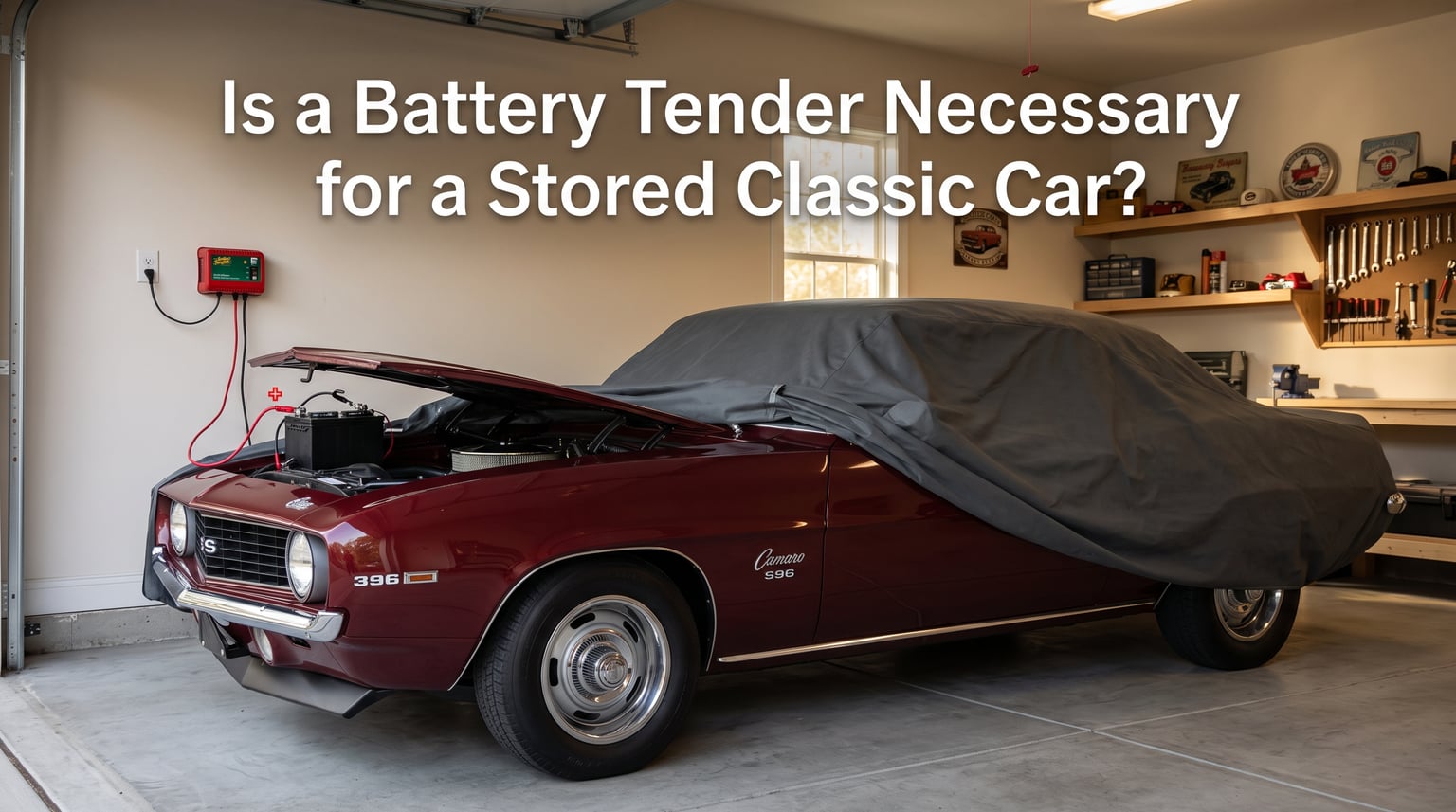
Yes, a battery tender is necessary for a stored classic car if it sits unused for more than two to four weeks at a time. Classic car batteries lose charge continuously through self-discharge and parasitic drain, even when the ignition is off and the vehicle is sitting quietly in your garage.
Without a battery tender maintaining the charge, sulfation begins forming on the battery plates within just a few weeks. Sulfation is a chemical process where lead sulfate crystals build up on the battery’s internal plates, and once those crystals harden, they permanently reduce the battery’s capacity and lifespan.
Our team has seen classic car owners replace batteries every two to three years when stored without maintenance. The same owners who use a quality battery tender regularly report their batteries lasting seven, eight, even nine years or more. The difference is that dramatic.
In this guide, we will walk through exactly what happens inside your battery during storage, how long you can safely go before damage starts, and why a battery tender is the single most cost-effective investment you can make for your classic vehicle’s electrical system.
Table of Contents
What Happens to a Classic Car Battery in Storage
A car battery does not simply hold its charge while sitting idle. It actively loses energy every single day through two main processes: natural self-discharge and parasitic drain from the vehicle itself.
Self-discharge is a chemical reality of all lead-acid batteries. Even sitting on a shelf with nothing connected, a battery loses roughly one to five percent of its charge per week depending on temperature and battery condition. Older batteries discharge faster, and batteries in hot environments discharge even faster than that.
Parasitic drain compounds the problem when the battery is still connected to the car. Modern vehicles, including classic cars with any aftermarket electronics, pull small amounts of current constantly for things like clock radios, alarm systems, fuel injection computers, and stereo memory presets. Even a few millivolts of draw add up to a dead battery over weeks of sitting.
Classic cars with original wiring and no electronics still lose charge to self-discharge. The difference is the timeline. A completely stock 1965 vehicle with zero parasitic draw might take six to eight weeks to discharge critically. A classic car with a modern stereo and alarm system can hit that same point in two to three weeks.
The Sulfation Process: Why Batteries Die in Storage
Sulfation is the number one killer of stored car batteries, and understanding it helps explain why a battery tender is so important. Here is what happens chemically inside your battery when it sits partially discharged.
Inside every lead-acid battery, you have lead plates submerged in sulfuric acid and water. When the battery discharges, the acid reacts with the plates to produce lead sulfate. This is normal. The problem occurs when the battery sits in this discharged state without being recharged.
Those lead sulfate deposits start soft and spongy. If the battery gets recharged quickly, the sulfate converts back into active material and sulfuric acid. But if the battery stays discharged for days or weeks, that soft sulfate begins crystallizing and hardening onto the plates. This is sulfation.
Once lead sulfate crystals harden, they block the chemical reaction that produces electricity. The battery loses capacity, struggles to hold a charge, and eventually fails completely. A badly sulfated battery might show 12 volts on a meter but collapse under any real load because the hardened crystals have permanently reduced the active plate surface area.
The critical voltage threshold is around 12.4 volts. Below this level, sulfation accelerates rapidly. A healthy, fully charged car battery should read 12.6 to 12.7 volts. Once it drops below 12.4 volts, the clock starts ticking on permanent damage. Below 12.0 volts, you are in serious trouble and the battery may already be compromised.
How Temperature Affects Battery Life in Storage
Temperature plays a massive role in how quickly your stored battery degrades. Heat accelerates self-discharge and speeds up sulfation, while cold slows the chemical reactions but increases the battery’s internal resistance.
A battery stored at 80 degrees Fahrenheit will self-discharge roughly twice as fast as one stored at 50 degrees. If your garage hits 95 degrees during summer months, your battery is losing charge at an alarming rate. This is why classic car owners in hot climates like Arizona, Texas, and Florida report more battery failures than those in cooler northern states.
Freezing temperatures present a different danger. A fully discharged battery can actually freeze solid in cold weather because the electrolyte becomes mostly water instead of acid. A frozen battery often cracks internally, destroying it completely. A fully charged battery freezes around negative 76 degrees, but a discharged battery can freeze at just 20 degrees above zero.
The ideal storage temperature for a classic car battery is between 40 and 60 degrees Fahrenheit. At this range, self-discharge is slow and the battery remains stable. If your storage environment falls outside this range, a battery tender becomes even more important to counteract the effects of temperature.
How Long Can a Classic Car Sit Without a Battery Tender
This is one of the most common questions classic car owners ask, and the answer depends on several factors. But here are the general timeframes to keep in mind.
A healthy, fully charged battery in a classic car with minimal parasitic drain can sit safely for two to four weeks without significant damage. Beyond four weeks, you are entering the danger zone where sulfation begins forming. After eight weeks, a battery that started fully charged will likely be discharged to the point of damage.
Several factors shorten these timeframes considerably. If your car has an alarm system, stereo memory, or any electronic fuel injection, parasitic drain can cut your safe storage time in half. Hot ambient temperatures above 80 degrees accelerate everything. An older battery that is already three or four years old will discharge faster than a new one.
Classic car owners who store their vehicles for winter face a particularly high risk. A six-month storage period without any battery maintenance almost guarantees sulfation damage. Even disconnecting the battery entirely only buys you a little extra time before self-discharge takes its toll.
The members of collector car forums we follow consistently share the same experience: batteries stored without a tender for a full winter season rarely survive more than two seasons. Members using battery tenders routinely report the same batteries lasting five to nine years.
Signs Your Stored Battery Is Already Damaged
If your classic car has been sitting without a battery tender for an extended period, watch for these warning signs that sulfation has already begun:
The engine cranks slowly or struggles to start when you first try to fire it up after storage. This indicates the battery has lost significant cranking amps and capacity. A healthy battery should spin the engine briskly even after sitting.
The battery voltage reads below 12.4 volts even after you try to charge it with a standard charger. This suggests the battery has internal resistance from sulfation and cannot accept or hold a full charge anymore.
You hear clicking or the starter engages but does not turn the engine over. This is a sign the battery has enough voltage to show on a meter but not enough current capacity to actually do the work of starting the engine.
The battery case feels swollen or looks distorted. This can indicate the battery froze while discharged or has experienced severe internal damage from deep discharge cycles.
How a Battery Tender Protects Your Classic Car Battery
A battery tender works fundamentally differently than a standard battery charger, and this difference is exactly what makes it safe for long-term connection. Understanding how it operates helps explain why it is necessary for stored classic cars.
A standard battery charger pushes current into the battery at a fixed rate and keeps pushing regardless of the battery’s state of charge. Leave a standard charger connected for days or weeks, and it will overcharge the battery, boiling off the electrolyte and warping the plates. Standard chargers are for quick recharges, not maintenance.
A battery tender, by contrast, uses intelligent multi-stage charging. It monitors the battery’s voltage continuously and adjusts its output accordingly. Here is how the process works step by step.
Stage one is the bulk charge phase. The tender delivers its full amperage to bring the battery up to around 80 percent charge as quickly as safely possible. This is similar to what a standard charger does but with voltage regulation.
Stage two is the absorption phase. The tender holds the voltage steady while gradually reducing the current as the battery approaches full charge. This carefully tops off the last 20 percent without overcharging.
Stage three is the float phase, and this is where the magic happens. Once the battery reaches full charge, the tender drops to a maintenance voltage, typically around 13.2 to 13.4 volts. At this level, the battery receives just enough current to offset self-discharge without overcharging. The tender can sit in this state for months or years without damaging the battery.
Quality battery tenders also include temperature compensation, adjusting the float voltage based on ambient temperature. In hot conditions, the tender lowers the voltage slightly to prevent overcharging. In cold conditions, it raises the voltage to ensure the battery stays fully charged. This is something a basic trickle charger simply cannot do.
By keeping the battery at optimal float voltage, a tender prevents the voltage drop that triggers sulfation. The lead sulfate stays soft and converts back normally when the engine runs. The battery plates remain clean and active, extending the battery’s usable life by years.
Battery Tender vs Trickle Charger vs Disconnect: Which Method Works Best
Classic car owners have three main options for battery care during storage, and each works differently. Understanding the distinctions helps you choose the right approach.
Battery Tender (Smart Maintainer): This is the recommended approach for classic cars stored more than two weeks. A battery tender monitors voltage automatically, switches to float mode at full charge, and compensates for temperature changes. You connect it and forget about it for the entire storage season. Quality tenders include spark-proof connectors, reverse polarity protection, and multi-stage charging algorithms designed for long-term connection.
Trickle Charger: A trickle charger delivers a small, constant current to the battery regardless of its charge state. The problem is that older trickle chargers have no automatic regulation. They keep feeding current even when the battery is full, leading to overcharging, water loss, and eventual plate damage. Modern smart trickle chargers with automatic shutoff behave more like battery tenders, but traditional constant-current trickle chargers are risky for unattended long-term use.
Disconnecting the Battery: Some classic car owners simply disconnect the negative terminal and call it done. This eliminates parasitic drain, which helps. However, it does nothing about self-discharge. A disconnected battery still loses one to five percent of its charge per week from natural chemical processes. Over a six-month winter, even a disconnected battery will discharge far enough to begin sulfating. Disconnecting also resets radio presets, clock settings, and any computer memory in vehicles with electronic systems.
For short-term storage of two to four weeks, disconnecting the battery can work in a pinch. For anything longer, a battery tender is the clear winner because it addresses both parasitic drain and self-discharge simultaneously.
What About Battery Tender Plus or Jr Models?
When classic car owners discuss battery tenders, they often mention specific models like the Battery Tender Junior and Battery Tender Plus. These are popular choices with good reason.
The Junior model delivers 0.75 amps, which is plenty for maintaining most standard car batteries during storage. It is compact, affordable, and includes basic multi-stage charging with temperature compensation. For a single classic car stored seasonally, this model covers the basics well.
The Plus model delivers 1.25 amps and adds more robust temperature compensation along with a slightly faster initial charge. For larger batteries or batteries that have been deeply discharged, the extra amperage helps bring them back to full charge more quickly before entering float mode.
Regardless of brand, look for these features in any battery tender you choose: automatic float switching, temperature compensation, spark-proof quick disconnect connectors, and reverse polarity protection. These features ensure safe, unattended operation over long storage periods.
Classic Car Battery Storage Best Practices
Using a battery tender correctly is just one part of proper classic car battery storage. Following these best practices ensures your battery stays healthy and your vehicle is ready to start when you need it.
Install ring terminal connectors. Instead of clipping the tender directly to the battery posts every time, install permanent ring terminal harnesses on the battery terminals. Run the quick-disconnect plug to an accessible location under the hood or through the grille. This lets you plug and unplug the tender in seconds without opening the hood or touching the terminals.
Connect correctly every time. Always connect the positive lead first, then the negative lead. When disconnecting, remove the negative lead first, then the positive. This prevents accidental short circuits if your wrench slips and contacts the chassis while touching a terminal.
Check electrolyte levels on serviceable batteries. If your classic car has a traditional flooded lead-acid battery with removable caps, check the electrolyte levels before and after the storage season. Top off with distilled water only, never tap water. A battery tender will not fix a battery that has run dry.
Clean the terminals before storage. Corrosion on battery terminals increases resistance and interferes with the tender’s ability to maintain proper voltage. Clean the posts with a wire brush and apply a thin coat of dielectric grease or anti-corrosion spray before connecting the tender.
6V vs 12V Systems: Classic Car Considerations
Pre-1955 classic cars often use 6-volt electrical systems instead of the modern 12-volt standard. This creates specific considerations for battery maintenance that many guides overlook entirely.
If your classic car has a 6V system, you absolutely must use a battery tender designed for 6-volt batteries. Connecting a 12V tender to a 6V battery will overcharge it rapidly, causing damage within hours. Conversely, a 6V tender cannot properly maintain a 12V battery.
Many quality battery tenders include a switchable 6V and 12V mode, making them versatile for collectors with vehicles from different eras. If you own both 6V and 12V classics, look for a tender that handles both voltages to avoid accidentally using the wrong setting.
6V batteries also tend to self-discharge slightly faster than 12V batteries of equivalent size, making a tender even more important for pre-1955 vehicles. The lower system voltage means there is less margin before the battery reaches the sulfation danger zone.
Charging Safety in Enclosed Spaces
One concern that comes up frequently in classic car forums is whether it is safe to leave a battery tender connected in a closed garage. The short answer is yes, with a few precautions.
Modern battery tenders with automatic float mode produce minimal gassing because they never push excess voltage. Unlike older chargers that can boil a battery, a quality tender maintains the battery at a voltage that does not break down the electrolyte into hydrogen and oxygen gas.
However, if your battery has removable caps and you are charging at high amperage during the bulk phase, some gassing is normal. Ensure the storage area has basic ventilation. Never charge a battery in a completely sealed, airtight space.
Keep the tender itself away from direct contact with the battery if possible. Mount it on a wall or place it on a stable surface where air can circulate around it. Tenders generate some heat during operation, and proper airflow prevents thermal issues.
The Real Cost: Battery Tender Investment vs Battery Replacement
When classic car owners ask whether a battery tender is truly necessary, the cost comparison often settles the debate quickly. Let us break down the actual numbers.
A quality lead-acid battery for a classic car typically runs between $100 and $250 depending on size and type. If you store your car without a tender and replace the battery every two to three years due to sulfation damage, you are spending that amount repeatedly over the years you own the vehicle.
A decent battery tender costs roughly $40 to $80 for a quality unit with all the safety features we discussed. That is a one-time purchase that can last a decade or more.
Classic car owners on collector forums consistently report that using a battery tender extends their battery life from two or three years up to seven, eight, or even nine years. At that rate, a single tender purchase pays for itself within the first saved battery replacement.
The cost extends beyond just the battery itself. A dead or damaged battery can leave you stranded at the worst possible moment, like the first nice day of driving season when you finally pull the car out of storage. There is also the hassle of jump-starting, potentially damaging sensitive original electronics with voltage spikes from jumper cables.
When you factor in the extended battery life, the avoided replacement costs, and the peace of mind knowing your classic is ready to start at a moment’s notice, a battery tender is one of the most cost-effective accessories a classic car owner can buy.
FAQs
Do collectible cars have to have a trickle battery?
Collectible cars do not technically require a trickle charger, but they absolutely need some form of battery maintenance during storage. A smart battery tender is the preferred method because it automatically regulates voltage and prevents overcharging. For any classic car stored more than two to four weeks at a time, a battery tender is strongly recommended to prevent sulfation damage.
What is the best way to store a classic car?
The best way to store a classic car includes connecting a battery tender to maintain charge, inflating tires to proper pressure, adding fuel stabilizer, changing the oil before storage, using a breathable car cover, and keeping the vehicle in a cool, dry environment. For battery care specifically, install ring terminal connectors on the battery and keep a tender connected for the entire storage duration.
How long can a car sit without a battery tender?
A healthy, fully charged battery can sit safely for about two to four weeks without a tender before sulfation begins. After four weeks, the risk of permanent damage increases significantly. A classic car stored for winter without any battery maintenance will almost certainly develop sulfation over a six-month period. Disconnecting the battery extends the safe period slightly but does not prevent self-discharge.
How to keep a stored car battery charged?
The most reliable way to keep a stored car battery charged is to connect a smart battery tender with automatic float mode. This device monitors voltage continuously and provides just enough current to offset self-discharge. For shorter storage periods, you can disconnect the negative battery terminal to eliminate parasitic drain, but a tender is the only method that addresses both parasitic drain and natural self-discharge simultaneously.
Is it bad to leave a battery maintainer on all the time?
No, it is not bad to leave a quality battery tender connected all the time. Smart tenders are specifically designed for continuous connection during long-term storage. They automatically switch to float mode once the battery reaches full charge and maintain it at a safe voltage indefinitely. This is exactly what they are built to do. You should only be concerned about leaving a charger connected if it is an older, non-regulated trickle charger without automatic shutoff.
Final Thoughts on Battery Tenders for Stored Classic Cars
So, is a battery tender necessary for a stored classic car? Without question, yes. A battery tender stored classic car setup is the single most effective way to protect your investment and ensure your vehicle starts reliably after any storage period.
The science is clear: self-discharge and sulfation will damage any battery left sitting without maintenance for more than a few weeks. A quality battery tender prevents this damage by maintaining optimal float voltage automatically and safely. The cost savings alone, extending battery life from two or three years to potentially nine years or more, makes a tender one of the cheapest insurance policies a classic car owner can buy.
If you take away one action from this guide, let it be this: install a ring terminal harness on your classic car battery today, connect a quality smart battery tender, and check on it once a month during storage season. Your battery, your wallet, and your future self will all thank you when that first beautiful driving day arrives and your classic fires up on the first turn of the key.