
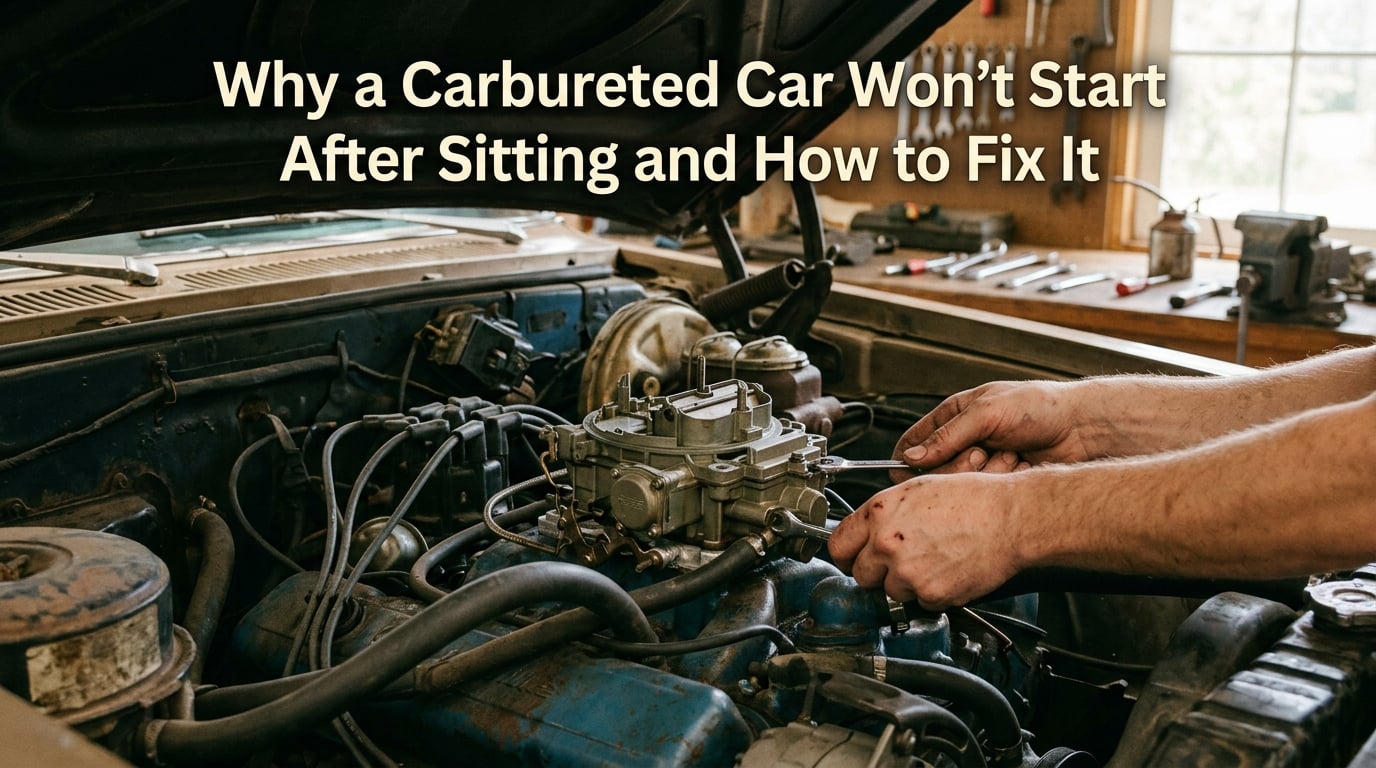
Last spring I walked out to my 1972 Cutlass, turned the key, and got nothing but a slow crank. The carbureted car wouldn’t start after sitting all winter, and I was stuck. After 30 minutes of frustration, a quick shot of starting fluid fired it right up. That experience sent me down a rabbit hole to understand exactly why carbureted cars fail after sitting, and how to fix the problem the right way.
This guide pulls together what I have learned working on Oldsmobiles, Mustangs, and other vintage rides, plus wisdom from mechanics on forums like Bob is the Oil Guy and Reddit’s r/AskMechanics. If your carbureted car won’t start after sitting, you will know exactly what to check and how to bring it back to life.
Table of Contents
Why Carbureted Cars Struggle After Sitting
Carburetors depend on a small reservoir of fuel sitting in the float bowl, ready to be sucked into the engine the moment you turn the key. Unlike modern fuel-injected systems that pressurize the line on demand, a carburetor has fuel exposed to air inside the bowl. When the car sits for days or weeks, that fuel slowly evaporates, leaving the bowl dry or partially empty.
Add varnish buildup, sticky choke linkages, and a fuel pump that may have lost its prime, and you have a perfect storm. I have personally seen Olds 350 carburetors where the float bowl was bone dry after just three weeks of sitting, especially in summer heat.
The chemistry is simple. Gasoline contains volatile compounds that evaporate at temperatures as low as 100 degrees Fahrenheit. Inside a warm engine bay, the float bowl acts like a small open cup, and fuel loss happens fast. Within 30 days, you can lose up to 50 percent of the volatile components that make gasoline easy to ignite.
The 7 Most Common Reasons Your Carbureted Car Won’t Start
Here are the top reasons I have encountered, ranked by how often they show up in classic car forums and on our own shop floor.
- Evaporated fuel in the float bowl – The most common cause, especially after 2+ weeks of sitting.
- Stale or varnished fuel – Old gas breaks down and leaves deposits that clog jets.
- Clogged carburetor jets – Tiny passages blocked by varnish and debris.
- Stuck or misadjusted choke – Choke plate stuck open or closed prevents proper cold-start fuel mix.
- Failed fuel pump check valve – Pump loses prime, fuel drains back to the tank.
- Flooded carburetor – Over-priming leaves the engine fuel-washed and unable to fire.
- Weak battery or bad ignition components – Old spark plugs, weak coil, or dead battery mimic fuel problems.
Forum user MustangMike on r/classicmustangs put it this way: “Engine cranks but won’t start after 1 month sitting. I sprayed some starter fluid and it fired right up.” That points almost always to an empty float bowl.
Step-by-Step Diagnostic Process
Before you start replacing parts, walk through this quick diagnostic. I use it on every no-start carbureted car that comes through my garage.
Step 1: Listen and Smell
Turn the key to the run position. Do you hear the fuel pump prime for 2 to 3 seconds? If you smell raw gas under the hood, the engine may be flooded.
Step 2: Check for Spark
Pull a spark plug wire, insert a spare plug, and ground it against the engine. Crank the motor. You should see a strong blue spark. No spark means ignition, not fuel, is your problem.
Step 3: Test Fuel Delivery
Spray 2 to 3 seconds of starting fluid directly into the carburetor throat, then try to start. If it fires and dies, you have confirmed a fuel delivery problem. If it does not fire at all, your issue is ignition-related.
Step 4: Inspect the Carburetor
Look down the carburetor throat while someone moves the throttle. You should see a squirt of fuel from the accelerator pump nozzle. If not, the float bowl is dry or the pump is bad.
This diagnostic takes about 10 minutes and saves hours of guessing. A Bob is the Oil Guy regular summed it up: “Spray some starting fluid into the carburetor. If it does not fire up right away you either have no spark or fouled plugs.”
How to Start a Carbureted Car That’s Been Sitting
Once you have confirmed it is a fuel issue, follow this proven starting procedure. I have used these exact steps on dozens of Oldsmobiles from the 1960s through the 1980s.
- Press the gas pedal to the floor once and release. This sets the choke and clears any flood condition on most carburetors.
- Turn the key and crank for 5 seconds. Do not pump the pedal during cranking on most carburetors.
- If it does not start, wait 10 seconds. This prevents overheating the starter and lets the fuel pump re-prime.
- Crank again for 5 seconds. Repeat up to three times before moving to step 5.
- Try one short shot of starting fluid. Use it sparingly. Two seconds maximum through the carburetor throat.
- Once it starts, keep your foot off the gas. Let the idle stabilize for 2 to 3 minutes before driving.
One key detail. On carburetors without a primer button, you may need to manually work the throttle linkage a few times to pump fuel into the bowl. Do this before cranking, not while cranking.
Common Fixes for Each Problem
Now that you know what is wrong, here is how to fix each issue. Most are weekend projects with basic tools.
Fix 1: Refilling the Float Bowl
Turn the ignition to run for 5 seconds, then off. Repeat three times. This primes the fuel pump and refills the carburetor bowl. If your pump is healthy, this alone often solves the no-start condition after sitting.
Fix 2: Draining and Replacing Stale Fuel
For fuel older than 60 days, drain the tank and carburetor bowl. Remove the float bowl drain plug or use a hand pump to empty the tank. Refill with fresh gasoline. I recommend adding a fuel stabilizer even if you plan to drive the car soon.
Fix 3: Cleaning Clogged Jets
Remove the carburetor from the engine. Soak it in carburetor cleaner for 4 to 8 hours. Use compressed air to blow out the main jets, idle jets, and accelerator pump passages. Never use wire on the jets, as it damages the precisely sized holes.
Fix 4: Freeing a Stuck Choke
Spray penetrating oil on the choke linkage and thermostat spring. Work the choke plate open and closed by hand until it moves freely. If the choke pull-off is broken, replace it. A stuck choke will leave you fighting the engine every cold start.
Fix 5: Replacing the Fuel Pump Check Valve
Many mechanical fuel pumps have a check valve that keeps fuel in the carburetor bowl. When this fails, fuel drains back to the tank overnight. Replace the pump or, on some models, just the check valve. This fix alone transformed my Cutlass from “starts after 30 minutes of cranking” to “fires right up.”
Fix 6: Clearing a Flooded Carburetor
Hold the gas pedal to the floor and crank for 10 seconds. The wide-open throttle cuts fuel flow on most carburetors and lets the excess evaporate. Wait 5 minutes, then try starting normally without touching the pedal.
Fix 7: Restoring Ignition Components
Replace spark plugs, plug wires, distributor cap, and rotor if they are more than 3 years old. Test the coil resistance. A weak battery that barely cranks the engine will not start a carbureted car reliably.
Prevention Tips for Long-Term Storage
If you store a classic car for more than 30 days, a few minutes of prep saves hours of troubleshooting later. Here is the routine our team uses on every Olds we put away for the winter.
- Add fuel stabilizer – Use STA-BIL or Sea Foam at the recommended ratio, then run the engine for 5 minutes to circulate it.
- Disconnect the battery or hook up a battery maintainer to prevent dead cells.
- Place the car on jack stands if storing more than 90 days to prevent flat spots.
- Top off the fuel tank – A full tank leaves less air space and slows evaporation.
- Cover the air intake with a plastic bag and a rubber band to keep critters out.
- Change the oil before storage to prevent acid buildup in used oil.
One AACA forum member put it well: “The real problem is that fuel evaporates when the car is not driven regularly. Couple this with a weak fuel pump and you get hard starting problems after sitting.” Prevention is far cheaper than rebuilding a carburetor because of varnish damage.
Frequently Asked Questions
How do you start a carbureted engine that has been sitting?
Press the gas pedal to the floor once and release, then crank for 5 seconds. Repeat up to three times with 10-second rests between attempts. If it still does not start, spray 2 seconds of starting fluid into the carburetor throat and try again. Once running, let it idle for 2 to 3 minutes before driving.
Why is a carburetor engine hard to start after sitting?
Fuel evaporates from the float bowl when a carbureted car sits, especially in warm weather. Stale fuel also leaves varnish that clogs jets, and the choke mechanism can stick. The engine has no fuel to ignite, so it cranks but will not fire. Adding fuel stabilizer and exercising the engine weekly prevents this.
What can cause a car to not start after sitting for a while?
The most common causes are an empty float bowl from fuel evaporation, clogged carburetor jets from varnish buildup, a stuck choke, a failed fuel pump check valve, a flooded carburetor from over-priming, weak battery voltage, or fouled spark plugs. Diagnose by spraying starting fluid into the carb to test if it is a fuel or ignition issue.
What can I spray in my carburetor to start my engine?
Use starting fluid (ether-based spray) sparingly. Two seconds into the carburetor throat is enough. Never spray starting fluid on a warm engine or near a hot exhaust, as it is highly flammable. For a flooded carburetor, holding the throttle wide open while cranking clears the excess fuel without needing spray.
How long can a carbureted car sit before starting problems?
Most carbureted cars begin showing hard starting after 2 to 4 weeks of sitting. In hot climates, fuel can evaporate from the bowl in as little as 7 days. With fuel stabilizer added and a full tank, a carbureted car can sit for 6 to 12 months and still start with minimal priming.
Final Thoughts
A carbureted car that won’t start after sitting is one of the most common headaches for classic car owners. The fix is usually simple once you know where to look. Start with the float bowl, work through fuel delivery, then check ignition if fuel is not the issue.
For Oldsmobile owners running Quadrajets or Rochester carburetors, the same principles apply. Take 15 minutes before storage to add fuel stabilizer, top off the tank, and disconnect the battery. Your future self will thank you when spring arrives and the engine fires on the first crank.